
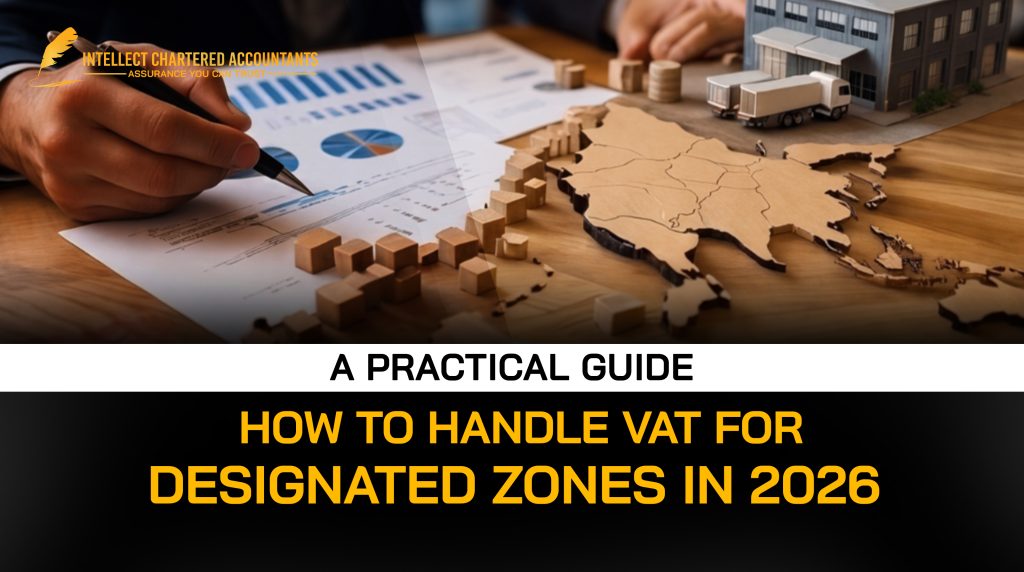
Midway through 2026, handling VAT in UAE Designated Zones feels more complex than ever. Because of new rules tucked into Federal Decree-Law No. 16 of 2025, things shifted sharply on January 1st. The FTA now peers much closer at filings—less guesswork, more proof. Oversight tightened just when businesses least expected it, making precision far more critical today than twelve months ago.
Inside these zones, companies face a tax blur: acting like they’re outside the UAE while still being treated locally for certain activities. Staying on track without fines means getting clear on how VAT works in Designated Zones by 2026.
1. The Goods vs. Services Dichotomy
“Outside the UAE” status is a label that sticks mostly to physical items. A common misconception in 2026 is that every corner of a Designated Zone skips VAT; in truth, it only covers specific product transactions.
- Service Rules: Services offered inside a Designated Zone still carry the standard 5% VAT. Whether you are providing consulting, legal help, or local transport, each counts as a mainland transaction.
- The Exception: Only when a service fits the strict definition of an “overseas export” under broader UAE tax guidelines does it escape this rule. Spotting this difference is the foundation of your 2026 tax strategy.
2. Navigating the “Consumption Trap”
Items escape taxation only when meant for reselling, processing, or transfer within the zone. If goods are used for internal operations, the tax status shifts immediately.
- Internal Use: When buying supplies like desks, chairs, or stationery for daily work inside the Designated Zone, companies must treat them as “consumed.” This triggers a 5% VAT charge.
- Audit Focus: Because audits became more frequent during 2026, firms face closer scrutiny on whether they are wrongly labeling regular administrative expenses as tax-exempt stock.
3. Decree-Law No. 16 of 2025: Administrative Relief
Early 2026 brought a significant ease of burden for those managing VAT in Designated Zones. The requirement for companies to create their own “self-invoices” for Reverse Charge Mechanism (RCM) deals is now gone.
- Simplified RCM: Registered businesses can now handle RCM VAT directly through their regular tax filings when bringing items into the mainland.
- Prerequisite: As long as customs papers and shipping records stay in place, the process is seamless. This shift reflects the UAE’s commitment to digital tracking and faster movement across zone lines.
4. Inter-Zone Transfers and Documentation
Goods moving between two Designated Zones (e.g., Jafza to KIZAD) stay outside tax rules only if they remain under continuous customs control. However, the paperwork required in 2026 has become much tougher.
The Compliance Gap: One missing paper can cause the transfer to fail tax-free status. Every Exit slip, Entry note, and customs-approved invoice must flow without breaks. If records show a hole, officials view it as a delivery to the mainland, triggering an immediate 5% charge.
5. The Five-Year Refund Rule
Time flies when paperwork piles up. Firms in Designated Zones now have a strict 60-month window to claim back extra VAT.
- Credit Balances: Many businesses build up large credits because they pay VAT on high-cost services while selling goods at a 0% rate.
- The Hard Deadline: Starting in early 2026, claims for these credits must arrive no later than five years after the tax period they are tied to. If you miss that window via the EmaraTax portal, those credits vanish permanently.
Intellect Chartered Accountants
Should you need help with VAT rules in the UAE’s Designated Zones, specialists are ready at our Business Bay location. A professional review can clarify your company’s duties under the latest 2026 regulations.
- Location: Office 807, Clover Bay Tower, Business Bay, Dubai, UAE (Near Burj Khalifa)
- Phone: +971 4 222 9911
- Email: info@intellectca.ae
- Website: www.intellectca.ae